“Is there something better than a chatbot for my website?”
A chatbot gives them a thread. A Brief gives them a page.
A Brief is your business’s own AI, on your own website: it knows what your business knows, and answers every customer with a page in your brand. Where a website chatbot gives your customer a thread of messages in a corner bubble, a Brief gives them a designed page, and gives you every question they asked.
01One question, two answers
A parent asks a school’s website: when’s your next open morning?
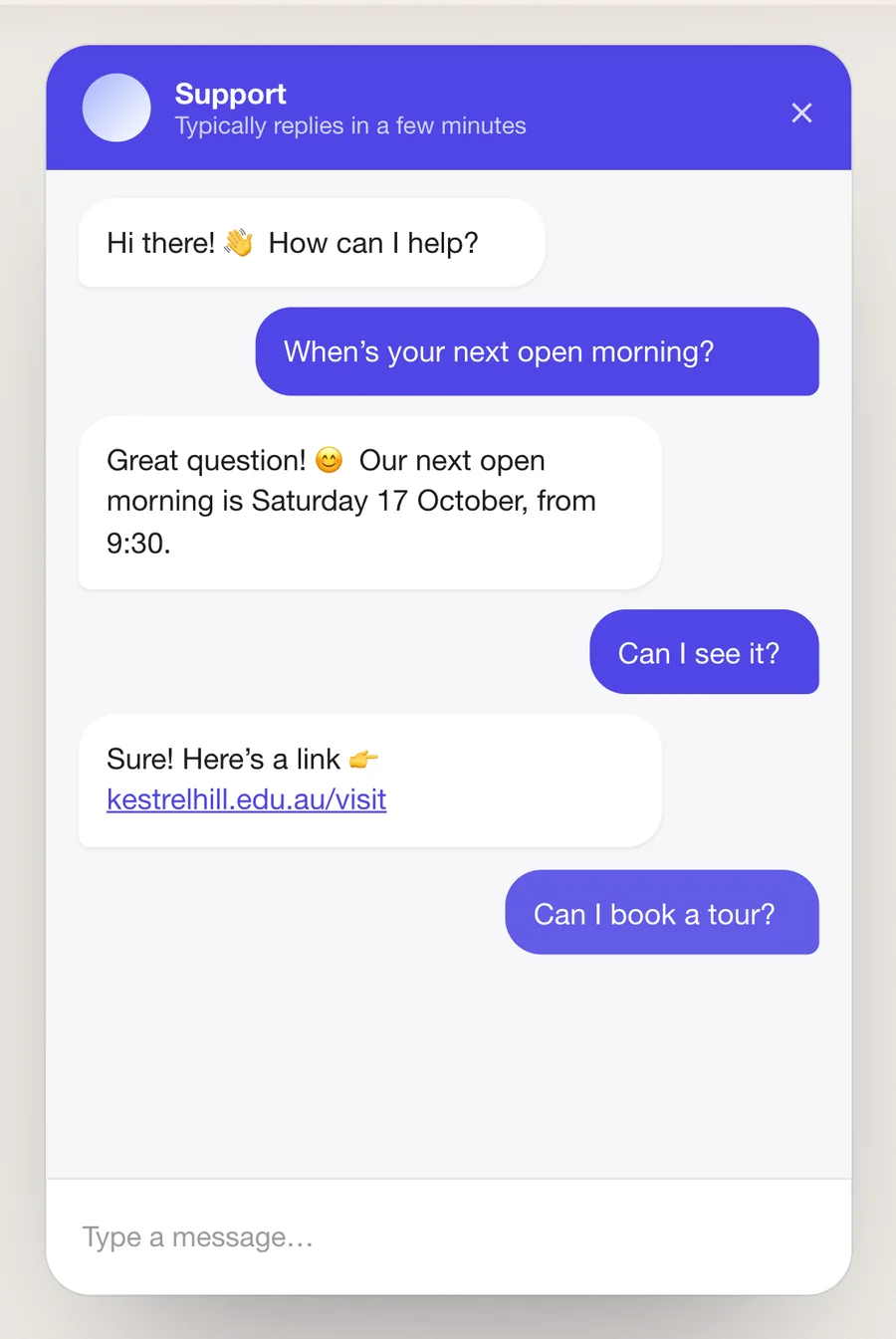
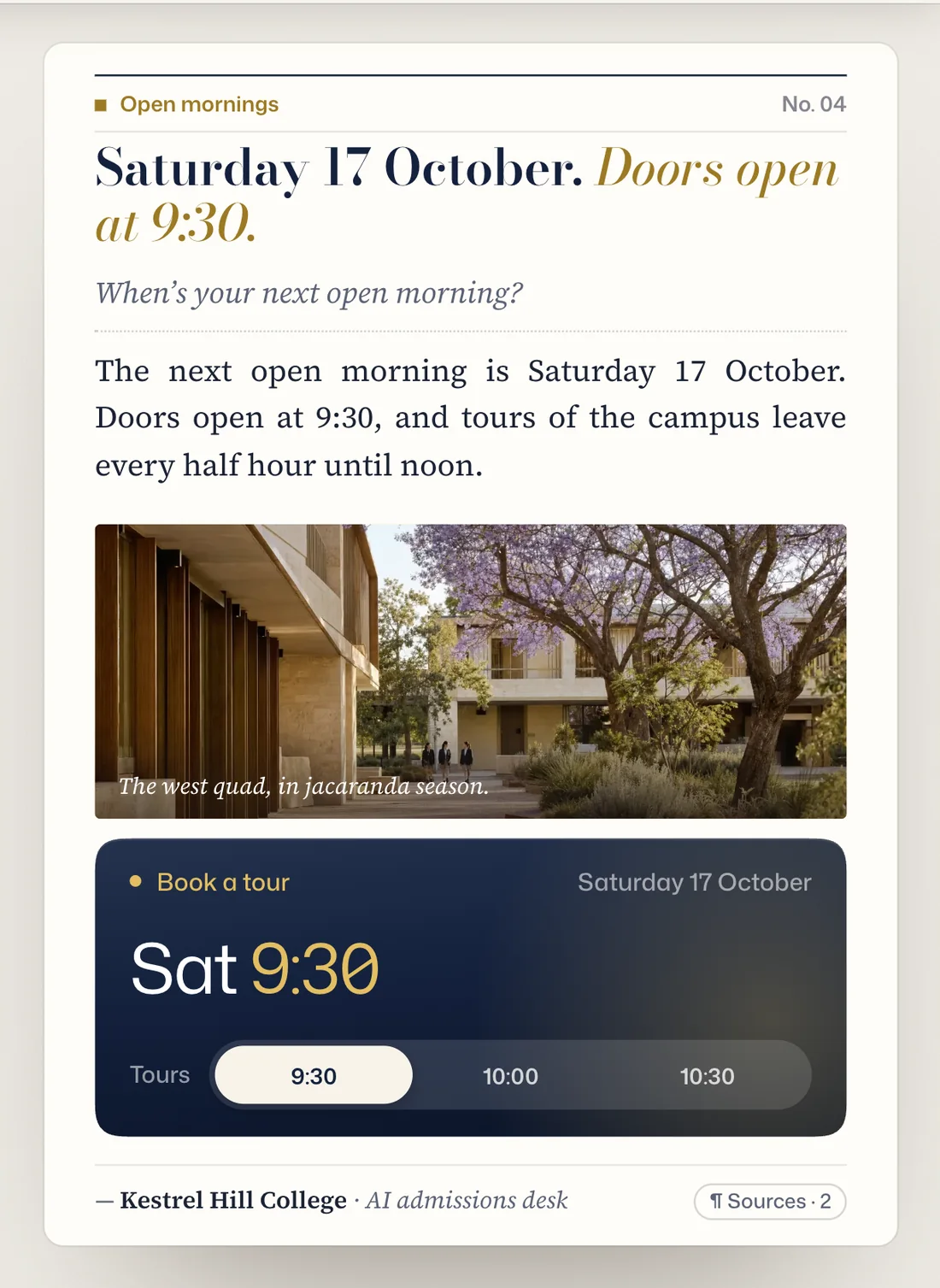
A Brief keeps only the answer and sets it as a page. Under the headline are the tour times, a photograph of the campus and a button to book a place, drawn from the school’s own calendar. The next questions a parent usually asks are waiting underneath.
Someone deciding whether to enrol, buy or book wants the answer, the picture and the next step together, and they want it to look like it came from you.
Kestrel Hill College is a made-up school, used as an example.
02Side by side
| What differs | A typical website chatbot | A Brief |
|---|---|---|
| What the visitor sees | A bubble in the corner that opens a thread of messages | A page on your site: headline, answer, photograph, widget |
| How it reads | A conversation, with greetings and follow-ups | An article. The answer comes first |
| Whose brand | The vendor’s widget, in your colour | Your type, your colours, your photographs, your voice |
| What it knows | The pages and articles loaded into it | What your business knows, including the answers your website never gave |
| Beyond text | Links and buttons | More than thirty kinds of widget: prices, dates, steps, maps, timelines |
| What stays | A thread that scrolls away | A page the visitor can keep, come back to and share |
| When it doesn’t know | Depends on the product and how it is set up | It says so, offers a person, and shows you the gap |
| How you pay | Usually by use: per resolution, conversation or message | A flat A$390 a month. Never per question |
| What you get back | Chat transcripts | Every question in your customers’ words, a monthly intelligence report, and answers AI search can read |
“A typical chatbot” describes the common self-serve products; they differ, and some do more. Their current prices are in the guide.
03What customers make of chatbots
- 64%
of customers would prefer that companies didn’t use AI in their customer service. Gartner, 5,728 customers, 2024.
- 14%
of customer service issues are fully resolved in self-service. Gartner, the same survey.
- 1 in 5
Nearly one in five consumers who used AI for customer service saw no benefit from it, almost four times the rate for AI in general. Qualtrics, more than 20,000 consumers in 14 countries including Australia, 2025.
And a business answers for what its website says. In 2024 a Canadian tribunal held Air Canada liable after its website chatbot gave a customer wrong information, noting that the airline “is responsible for all the information on its website”. (Moffatt v. Air Canada, 2024 BCCRT 149.)
We tested it ourselves. The Ringlio Website Chatbot Test 2026 found that 62% of 71 website chatbots gave at least one wrong answer on a point that changes a buying decision, when asked hard pre-purchase questions.
None of this is an argument against AI on a website. It is an argument about the form it takes, and about what it is allowed to say.
04Why not leave it to ChatGPT?
Your customers can already ask ChatGPT about you. It answers from what it can find online, plus the few details you can now add to a profile there.
Much of what they want to know was never published: next year’s fees, whether you deliver on a Sunday, how long an approval takes. Those answers live in your documents and in your head.
A Brief answers from what your business knows. It finds the gaps from real questions, you fill them once, and from then on every customer gets the answer on your own website. Once it is written down there, AI search can cite it too.
05Where a Brief fits
If you are looking for an alternative to a chatbot on your website, a Brief is the one built for customers who are deciding, not customers who need support.
- Your customers ask before they commit
Schools, agencies, developers, clinics, venues, trades, product companies: the questions are about price, time, place and process.
- How it looks matters to you
You have spent money on your brand and your photographs, and you don’t want a stranger’s chat widget on top of them.
- You want to know what people ask
The questions themselves are the point: what your customers want to know, and what your website never told them.
- You want the serious ones to call
A visitor who is ready to talk reaches the right person, with everything they read attached.
A Brief answers from your documents. It isn’t a helpdesk: there is no shared inbox or ticketing, and it doesn’t look up a customer’s order or account.
06Questions about the difference
How is a Brief different from an AI chatbot?
A chatbot gives your customer a thread of messages in a bubble in the corner of the screen. A Brief gives them a page: the answer first, then the photograph, figure or next step that goes with it, in your type and colours, and each new answer joins it.
A Brief also keeps working after the visit. It shows you every question your customers asked, including the ones your website couldn’t answer. See the two side by side.
Why not just let customers ask ChatGPT?
Many already do. ChatGPT answers from what it can find about you online, plus the few details a business can now add to its own profile there. Much of what customers want to know was never published: next year’s fees, whether you deliver on a Sunday, how long an approval takes.
A Brief answers from what your business knows, on your own website, where the customer is already looking. And once an answer is written down on your site, AI search can cite it too.
What happens when it doesn’t know the answer?
It says the answer isn’t on file and offers to pass the question to a person. The visitor leaves an email address or a phone number, and you receive it with their question and a link to the page they were reading. You also see the question itself, so the gap can be filled for the next customer.
What does it cost?
A$390 a month, plus A$500 once to build and set it up. There is no charge per question, and the contract is month to month.