“Can AI answer admissions questions on our school’s website?”
Every family’s question, answered in your school’s own voice.
Briefs gives a school its own AI, on its own website. A family asks about tours, enrolment or which year to start, and gets a page back: written from what your school knows, set in your school’s brand, with the next step beside it. It answers on two independent schools’ websites in Australia today, and its data is stored in Australia.
01What families ask, and when
Choosing a school takes months, and much of the reading happens at home in the evening, after the admissions office has shut.
The questions are specific. When is the next tour for Year 7? What are the steps to enrol? If my daughter was born in 2019, which year does she start? Is there a bus from our suburb? Some of the answers are in your prospectus. Some were never written down at all.
A Brief lets a family ask in their own words, and puts the answer in front of them as a page.
02What a school’s Brief does
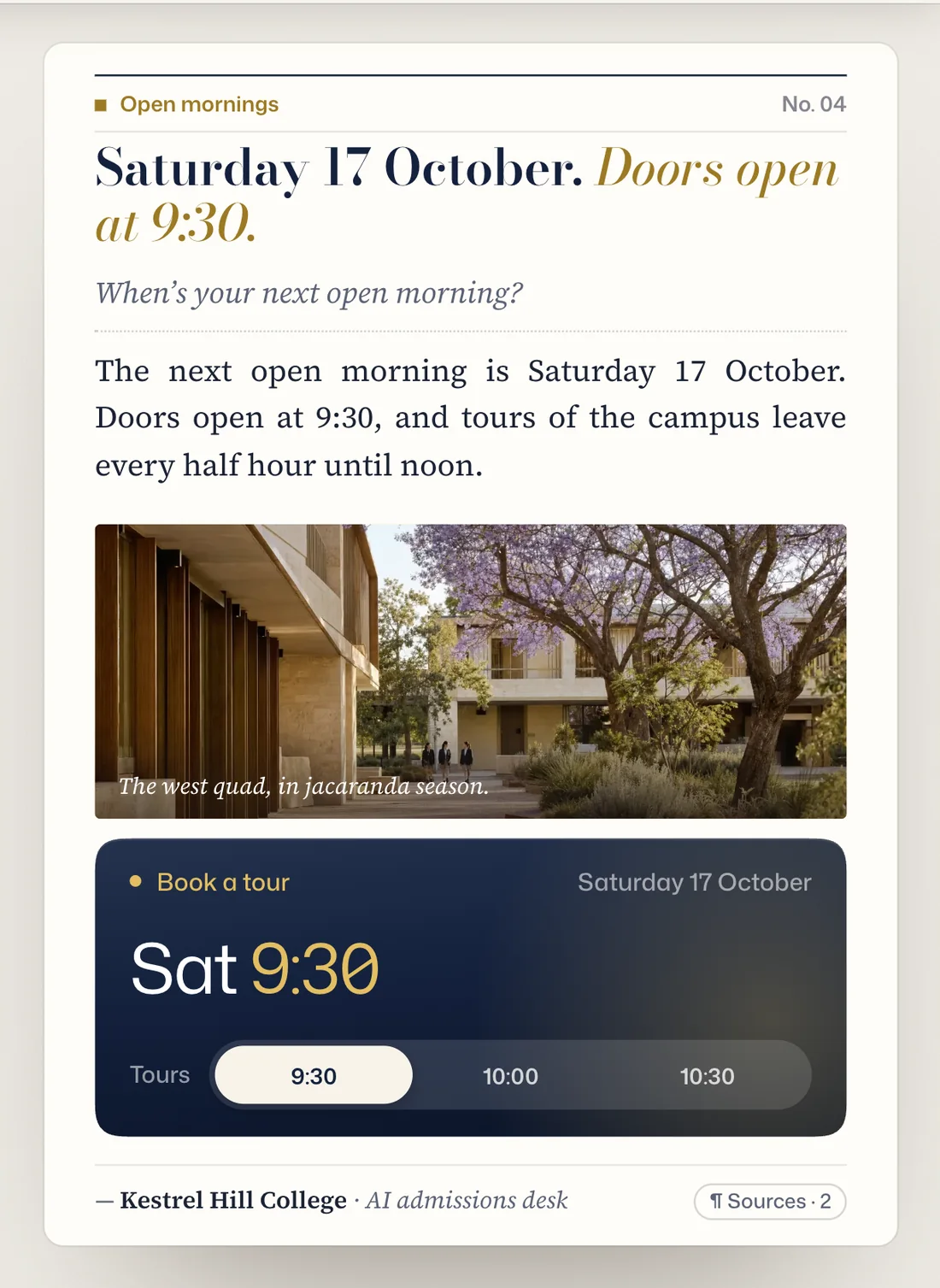
- Sets each answer as a page
A headline, a short answer, a photograph of your campus, and the next step: book a tour, register, call the registrar.
- Draws the answer when words aren’t enough
Widgets made for schools: the steps to enrol in order, which tour suits which year level, the entry year for a date of birth, the dates ahead, and fees by year group if you publish them.
- Knows what your school knows
Your website, prospectus, enrolment policy, handbooks and calendar, plus the answers your registrar gives to the questions none of those cover. It is the only material the AI is given.
- Appears on the pages that matter
The Admissions page can open with an answer about enrolment; the Boarding page with one about boarding. Each page can carry its own.
- Looks like your school
Your crest, your type, your colours and your photographs, on a phone and on a desktop.
03What Admissions gets back
Every question, in the family’s own words, with the time it was asked.
When a parent is ready to talk, they leave an email address or a phone number. It reaches your registrar with their question and a link to everything they read, so the first call starts where the family already is.
Each month an intelligence report sets out what families asked, which topics are rising, and what your website doesn’t yet answer. Those gaps are the useful part: they are what families want to know and can’t find.
04When families ask ChatGPT instead
Parents now ask AI assistants about schools, and an assistant can only repeat what is written down.
A Brief shows you which questions your website can’t answer. When you answer one, it can be published as a page on your own website, where ChatGPT, Claude and Google can read it.
05On two schools’ websites now
Scotch College and Penrhos College, both in Perth, Western Australia, have a Brief on their websites.
Ask Scotch’s how to enrol and it sets out the school’s process as numbered steps, from the first enquiry to the welcome. Ask Penrhos’s which year a child would start and it works the answer out from her date of birth.
06The things a school has to be careful about
- It says so when it doesn’t know
A Brief answers only from your material. When an answer isn’t on file, it says so and offers to pass the question to Admissions. It does not guess.
- No student records
A Brief doesn’t connect to your student information system. It reads the documents you choose to give it.
- Stored in Australia
Your documents, families’ questions and the answers are kept on infrastructure in Sydney. Where your data lives names every provider.
- Never used to train AI
Not your content, and not your families’ questions.
- You approve it first
You see the finished Brief on a private link, and nothing goes on your website until you say so.
07Questions schools ask us
Where do the answers come from?
Only from your own website and the documents you provide. That is the only material the AI is given. Where your website leaves something out, you fill it in, so your Brief knows what your business knows, not only what it has published.
When the answer isn’t on file, the Brief says so and offers to pass the question to your team. It does not guess.
How do you keep it accurate?
A Brief is given only your own material. Before it tells a visitor that something isn’t on file, it searches your documents a second time, more widely. On a property listing, a price, a percentage or a room count is printed only if it is in that property’s documents.
Every Brief is tested against real customer questions and approved by you before it goes live. No AI is perfect, so when a Brief isn’t sure, it says so and offers a person.
Where is our data stored?
Your Brief’s data is stored in Australia, on infrastructure in Sydney: your documents, your customers’ questions and the answers. To compose an answer, the relevant passage is sent to our AI providers in the United States for processing. Where your data lives names every provider.
Is our content used to train AI?
No. Ringlio does not train AI models on your content or your customers’ questions, and its AI provider doesn’t either.
Does a Brief help us show up in ChatGPT and AI search?
It can. AI search can only cite what is written down, and the facts customers want most are often known only to you. A Brief finds those gaps from real questions. When you answer one, the answer can be published as a page on your own website, where ChatGPT, Claude and Google can read it.
It is part of every Brief. How it works.
What does it cost?
A$390 a month, plus A$500 once to build and set it up. There is no charge per question, and the contract is month to month.